A clear walk through of what the app does, how it reads a product, where the data comes from, and why the method is trustworthy: built on respected public standards and a transparent, auditable decision engine.
The problem
Around 1 in 10 adults and 1 in 13 children live with a food allergy, and many more manage sensitivities, religious rules, or special diets. Every grocery aisle and restaurant menu becomes a small risk assessment: tiny print, hidden names (milk hides as "casein," wheat as "semolina"), and labels in another language. LabelGuardian turns that stressful reading into a one second answer.
How it works
The core design choice: AI does what it is best at (reading messy text and photos), and a transparent rule engine makes the actual safety call. The verdict is never a black box.
A barcode, an ingredient-label photo, a menu photo, or a typed dish name.
Claude vision transcribes the ingredients and maps hidden names to allergen proteins. Barcodes are looked up in a public database.
A deterministic engine compares the ingredients to your profile using FDA allergen data. Same input, same result, every time.
A big green check or red stop, plus the exact ingredient that triggered it.
See it in action
Actual results from the live app, against a profile set to avoid milk and peanut.
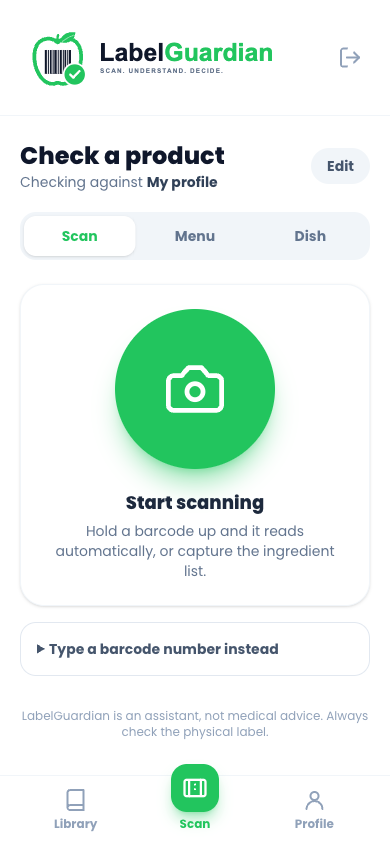
One tap to scan
Hold up a barcode and it reads automatically, or capture the ingredient list.
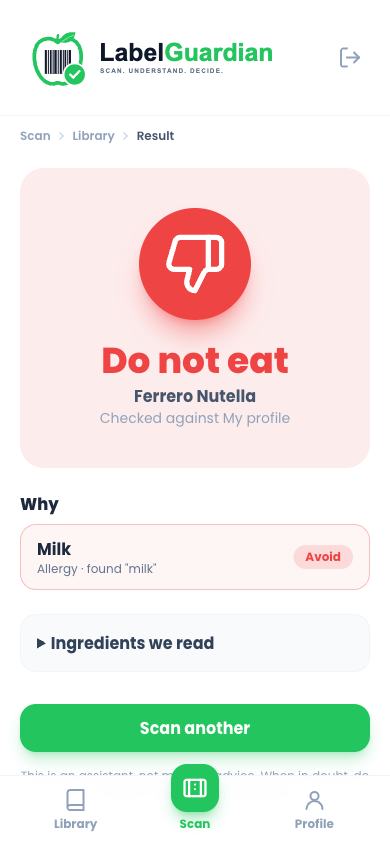
Nutella, flagged for milk
Barcode looked up in Open Food Facts. The exact trigger is shown: milk.
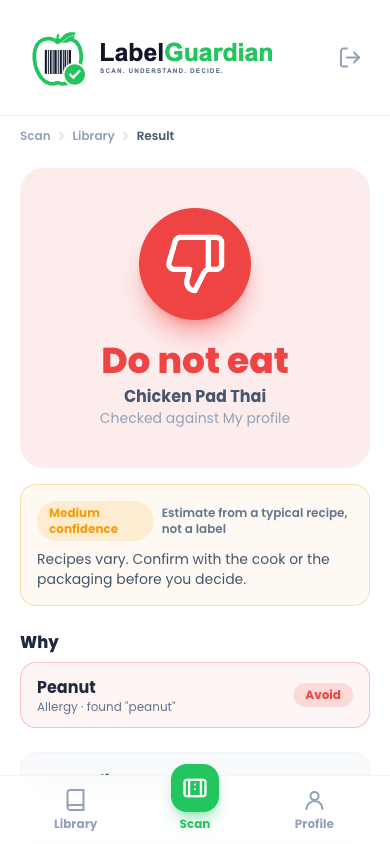
Pad Thai, estimated for peanut
A dish estimate with a clear confidence level, never presented as a label.
Where the data comes from
Three pillars, each chosen because it is open, recognized, and verifiable.
The Food Allergen Labeling and Consumer Protection Act defines the nine major allergens, milk, egg, fish, crustacean shellfish, tree nuts, peanut, wheat, soybean, and sesame, that cause the large majority of reactions. We seed this as built-in reference data, plus a curated list of hidden names per allergen (for example casein and whey for milk), and an extra Brassica / cruciferous group on request.
A free, collaborative, widely cited food database. For barcode scans we read its structured ingredient text and allergen tags. Because allergen tags are language independent, we catch milk on a French label that says "lait" even when the literal word "milk" never appears.
Claude reads photographed ingredient lists, menus, and dishes, transcribing the text and mapping derivative names to allergen proteins. It runs at the most deterministic setting available, and we constrain it to only report allergens that are actually present in the ingredients it lists.
Why it is reliable and valid
Allergen definitions come from the FDA standard, not from opinion. The match list is auditable text, not a model guess.
An allergen is flagged either when its name (or a known hidden name) appears in the ingredients, or when a trusted allergen tag is present. The barcode tags work across languages.
Matching uses word boundaries, so "soy" does not falsely trigger on "soylent," and the engine reports the exact term that caused a flag.
For menus and dishes, the AI may only flag an allergen that is actually in the ingredients it listed, not a "might contain" guess. This removed false positives such as dark chocolate being marked for milk.
Label and barcode scans are treated as facts to read. Menu and dish results are clearly labeled estimates with a high / medium / low confidence, never presented as a definitive label.
The final safe / unsafe / caution decision is a fixed rule set: same ingredients and same profile always give the same answer, so results can be explained and reviewed.
Every feature
Barcode, ingredient-label photo, restaurant-menu photo, and dish by name or voice.
Allergies (FDA Big 9, Brassica, and custom), sensitivities, religious rules (halal, kosher), and diets (vegan, vegetarian, pescatarian, keto).
A large green check or red stop, with the exact triggering ingredient and severity.
Every scan is saved, and products are cached so repeat lookups are instant and the catalog grows over time.
Photograph a menu and get a per-dish list of what to avoid, ranked, with confidence.
Ask about a dish by speaking, and take or upload a photo of the dish.
Adds to the home screen like a native app; profile and past scans remain available offline.
A clear not-medical-advice disclaimer and signed liability release at sign up; sensitive configuration encrypted at rest.
LabelGuardian pairs respected public data with a transparent decision engine, and it never pretends to be perfect. It is positioned clearly as an assistant, not a doctor, which keeps it safe to ship and trustworthy to use. That honesty is the brand.
For partners and investors: read the technical overview (password protected).